
The Satellite Industry in 2026: A Strategic Briefing
Where the industry is, how it got here, and what to watch in the next twelve months. For business and government leaders deciding where to put time, capital, and policy.

1. Seven years, seven times bigger
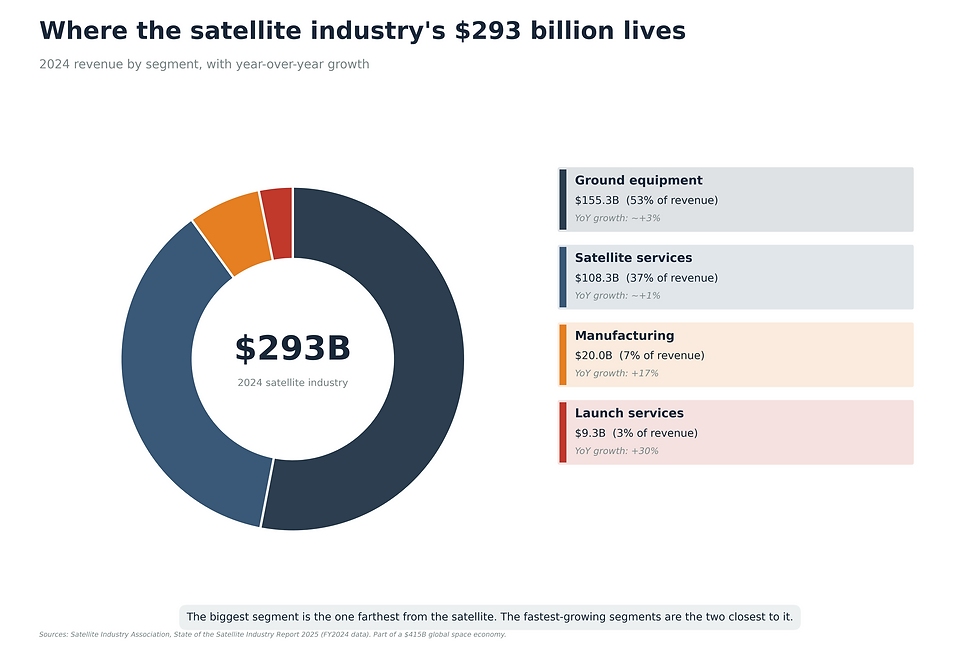
The satellite industry is a $293 billion business, part of a $415 billion space economy, and most of that money does not fly. More than half sits in the ground equipment, terminals, modems, software, and services that make every satellite link useful. Add the banking, broadcasting, defense, and navigation systems that quietly run on satellite signals, and the addressable market is larger still.
What makes all of it possible is what is in orbit. There are roughly 15,500 active satellites in Earth orbit today, up from about 2,000 seven years ago. The fastest infrastructure buildout of the past decade did not happen on the ground. It happened in space.
Roughly 10,200 of those satellites, about two-thirds, belong to Starlink, the broadband network operated by SpaceX. SpaceX is the name behind the pace, the reusable rocket, the launch cadence, and the public attention the industry has received over the past seven years. The rest of this article will return to what that lead has cost, what it cannot do, and who is building the architectures that come next.
Behind the headline is an industry sorting itself into layers. Commercial broadband. Sovereign communications. Defense. Earth observation. The ground equipment that makes any of it work. The next phase will not be decided by who has the most satellites in orbit. It will be decided by who builds the right infrastructure for what comes next. The pages that follow walk through where the value is moving, who is moving it, and what to watch in the next twelve months.

2. Three altitudes, three businesses
Three altitude bands carry almost everything.
Low Earth Orbit, below 2,000 km, holds about 13,300 active satellites. It is where most consumer broadband now lives. Fiber speeds. 99.9% fiber reliability. The other 0.1% is just satellites tag-teaming your dish.
Medium Earth Orbit, between 2,000 and 35,786 km, holds the navigation systems the world quietly runs on (GPS, Galileo, GLONASS, BeiDou) and SES's O3b mPOWER, the high-throughput commercial layer at this altitude.
Geostationary Orbit, at 35,786 km above the equator, parks fewer than 800 satellites in fixed positions, where a single satellite covers a third of the planet. The combined SES and Intelsat fleet is the largest commercial presence in this band.
Each band buys something. Each costs something else. The rest of the article is a tour of who is using which, and why.

3. The breakdown matters more than the headline
The breakdown matters more than the headline. Of the $293 billion the satellite industry earned last year, more than half went to ground equipment. $155 billion in terminals, antennas, modems, and the back-end systems that turn an orbital signal into a customer experience. Services, the actual broadband and broadcast and data feeds, brought in $108 billion. Manufacturing the satellites themselves grew 17% to $20 billion. Launching them grew 30% to $9 billion.
The pattern is investment-relevant. The biggest market segment is the one farthest from the satellite. The fastest-growing segments are the two closest to it. The first tells you where the working economy already lives. The second tells you where the next ten years of capital will be spent.
4. The launch cost revolution
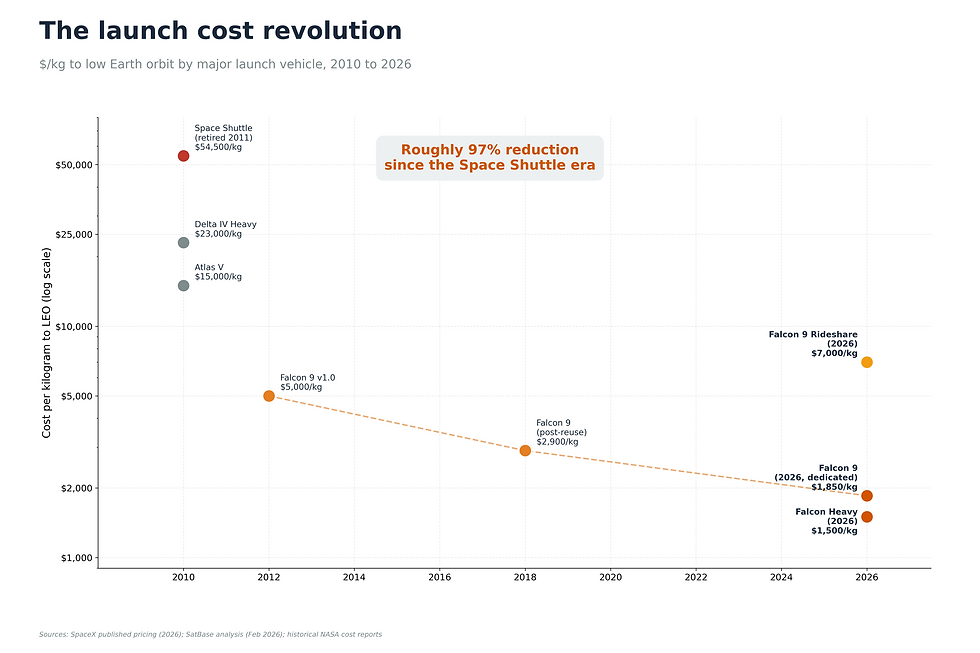
In the Space Shuttle era, putting one kilogram of payload into low Earth orbit cost roughly $54,000. Today a dedicated Falcon 9 launch costs about $1,850 per kilogram. The rideshare program for smaller payloads runs about $7,000 per kilogram. The cost of reaching orbit dropped by greater than 90% in roughly fifteen years.
That collapse, more than any other number, is why the orbital population went from 2,000 to 15,500 in seven years. It is also why manufacturing and launch are the fastest-growing segments of the industry.
The cost story has a co-author. SpaceX carries about 58% of global launch capacity. China carries another 32%. The rest is split among United Launch Alliance, Rocket Lab, Arianespace, Blue Origin, and newer entrants. The dependence on a single provider for most of the world's lift is real, and the next section is about what that means.
4b. Cost was solved. Capacity is not.
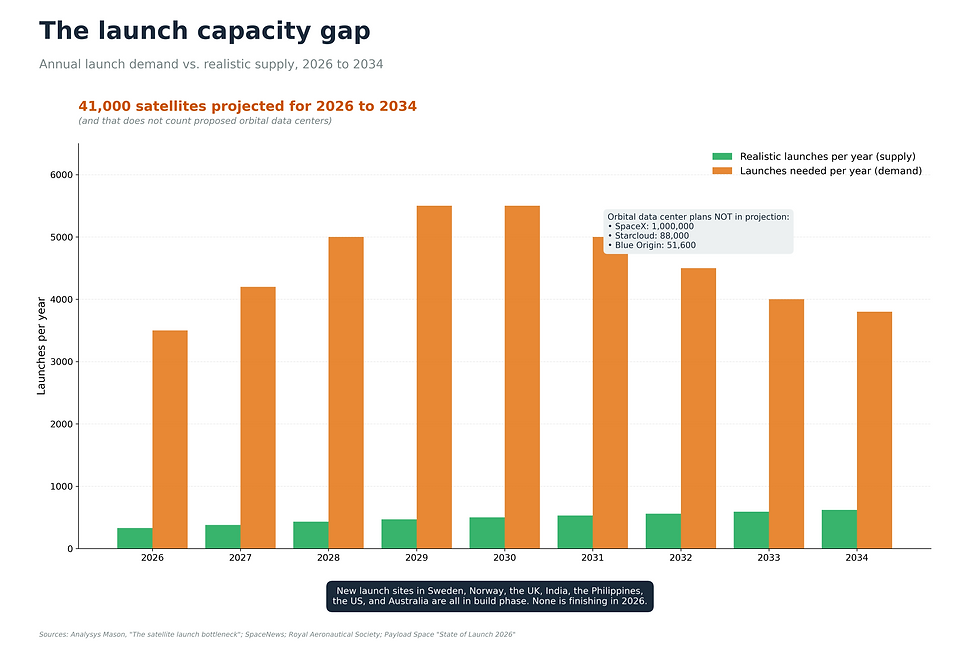
Cost was solved. Capacity is not. The world flew about 330 launches in 2025. The pipeline of announced satellites calls for far more.
Independent industry analysts project roughly 41,000 satellites will launch between 2026 and 2034. That number excludes the orbital data centers recently announced by SpaceX (1 million), Starcloud (88,000), and Blue Origin (51,600). The mismatch is not subtle.
Some of the gap will compress as rockets get larger. SpaceX's Starship, China's Long March 8A, Rocket Lab's Neutron, and Blue Origin's New Glenn are all scaling. But cadence depends on launch facilities. New pads at Cape Canaveral, Vandenberg, Esrange in Sweden, Andoya in Norway, Saxavord in the UK, Kulasekarapattinam in India, and Cagayan in the Philippines take years to permit and build. None is finishing in 2026.
The first concrete consequence is already visible. Amazon Leo will miss its FCC milestone of 1,618 satellites in orbit by July 30, 2026. The shortfall is launch slots, not money. Forward-looking projections that assume launch supply arrives on schedule are betting against physics, paperwork, and concrete.
5. The spectrum layer
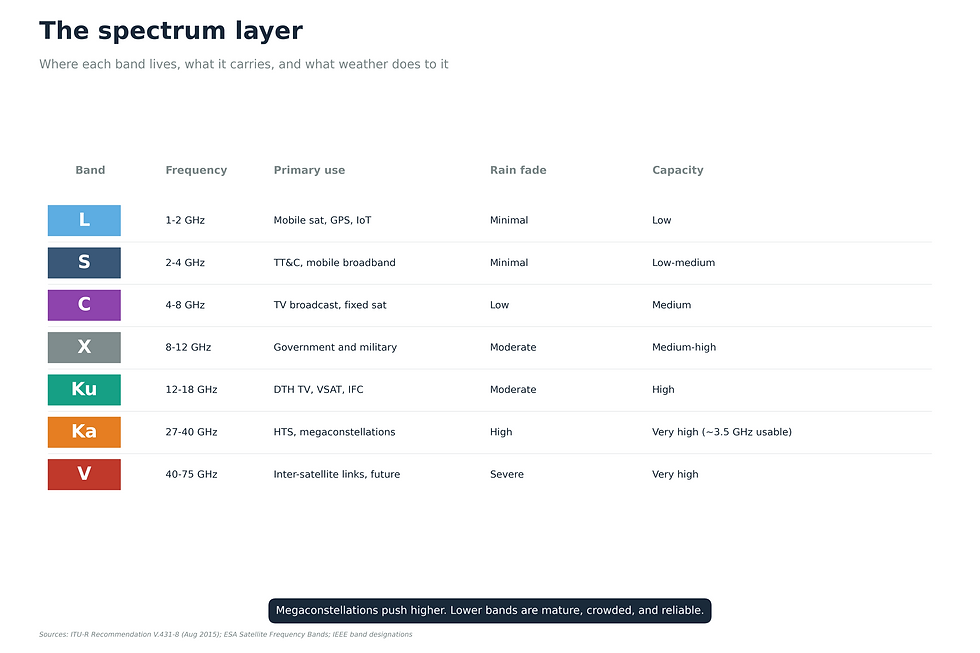
Every satellite link runs on a slice of radio spectrum, and the slices are not equal. Lower frequencies punch through rain but carry less data. Higher frequencies carry far more data but lose ground in weather.
L, S, and C-band are where the businesses that have always printed money live: TV broadcast, mobile satellite phones, and GPS in every smartphone. Reliable, narrow, mature.
Ku and Ka are where the megaconstellations live. Ka offers about 3.5 GHz of usable bandwidth, four times Ku, which is why Starlink, Amazon Leo, OneWeb, SES, and the Chinese constellations all push there. V-band is the next frontier.
Spectrum is regulated by the United Nations International Telecommunication Union and is genuinely scarce. The fights over who gets which slice are about to get louder.
6. The part of space infrastructure that is not in space
The $155 billion the satellite industry spent on ground equipment last year did not buy abstractions. It bought antennas, modems, terminals, and the buildings that house them. The ground segment is the part of space infrastructure that is not in space, and it is consolidating fast.
KSAT in Norway runs more than 280 antennas across 26 sites worldwide. Telespazio in Italy operates more than 200 antennas across eight space centers. SES runs gateway infrastructure for its GEO and MEO fleets. A sovereign Philippine teleport at Morong, near Subic Bay, being built and operated by Brightside with SES on behalf of the Philippine government, is under construction for service in the first half of 2027. Starlink runs more than 150 proprietary gateways. AWS Ground Station rents antennas by the minute. Goonhilly in the UK handles deep space and lunar.
The pattern matches the rest of the industry. The biggest players are getting bigger. The architectures that win combine reach, redundancy, and the ability to serve multiple operators at once.

7. Not getting bigger. Getting wider.
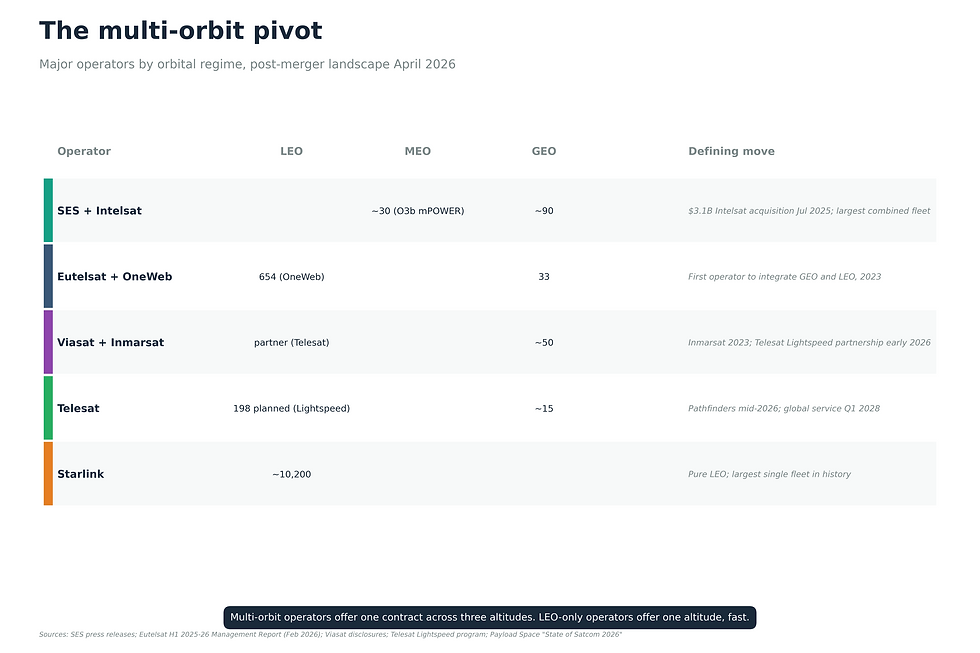
If LEO megaconstellations are one answer, multi-orbit is the other. The bet is that no single altitude wins every job, and the operators who own pieces of multiple orbits will deliver the right service at the right price.
The mergers that prove the thesis happened in two years. SES acquired Intelsat in July 2025 for $3.1 billion, creating a combined fleet of roughly 120 satellites: 90 in GEO, 30 in MEO. Eutelsat absorbed OneWeb in 2023, joining 33 GEO satellites with 654 in LEO. Viasat completed Inmarsat the same year and added a Telesat Lightspeed LEO partnership in early 2026.
SES is also building meoSphere, its next-generation MEO constellation, in partnership with K2 Space and with payload work in Luxembourg. It is set to expand capacity, flexibility, and resilience beyond the existing O3b mPOWER system, strengthening ground partnerships including the Brightside teleport at Morong, near Subic Bay.
Each now offers something Starlink does not: a single contract giving customers access to all three orbital regimes, with the link picking the right altitude in real time. Aviation, maritime, defense, and sovereign governments are the early adopters, because their missions need persistence, throughput, and latency at different moments.
The defining operator strategy of 2026 is not getting bigger. It is getting wider.
8. Today's lead, tomorrow's race
The current fleet is what is in orbit today. The announced fleet is what operators say will be in orbit by 2030. They are not the same picture.
With deployed satellites today, Starlink leads at about 10,200. OneWeb has 654. Amazon Leo is at 299 after the April launch. China's Guowang and Qianfan stand at 180 and 108. Planet Labs runs about 170 imaging satellites. Spire runs about 91. Iridium runs 66. SES O3b mPOWER has 10 of 13 in orbit.
By announcing the target, the picture is more contested. Starlink is licensed for 15,000 Gen2 satellites and has filed for 30,000. China's Qianfan and Guowang together target around 28,000. Amazon Leo plans 3,236. Eutelsat has ordered 440 more OneWeb. Telesat Lightspeed targets 198. EU IRIS² targets 290. If even half of these numbers materialize, the orbital population will more than triple by 2030.
Quantity is one factor, not the whole story. More satellites do not equal a better network. Spectrum rights, ground capacity, link reliability, line-of-sight elevation angles, and customer relationships all matter as much as raw fleet size.
The race is not between today's leaders. It is between today's leaders and the operators still in the build phase. The next decade will reward the ones who built the right architecture, not the largest fleet, and that distinction is the one buyers should be watching for.

9. The sovereign play
The sovereign play is the third architecture, after pure-LEO and multi-orbit. Governments are funding their own satellites, often through partnership with commercial operators that can build and operate at speed, because they want infrastructure whose sovereign control does not depend on someone else's commercial or political weather. The pattern leverages what the commercial industry does well, the building and the running, while keeping the authority that the government needs.
The largest funded examples are concrete. The European Union's IRIS² constellation targets 290 satellites across LEO and MEO with approximately €11 billion committed and deployment beginning in 2027. China's Guowang is a 13,000-satellite state-led broadband program. Telesat Lightspeed in Canada targets 198 satellites with global service in 2028. Regional plays include India's NavIC, Japan's QZSS, and newer national filings from Korea, the UAE, and Brazil.
Then there is the case study that pulls many of this article's threads together.
The Philippines is building BIYAYA, a sovereign software-defined satellite, in France for launch in 2027 and full service in 2028. Brightside Group and SES are partners co-investing in the future of the Philippines and the Indo-Pacific, alongside Philippine government partners. The program is multi-orbit by design, combining a sovereign GEO satellite with SES's medium-Earth-orbit constellation, anchored by the national teleport under construction at Morong, near Subic Bay. A new launch facility in Cagayan Province adds sovereign launch capability to the same national stack. The United States supports Philippine modernization, including under the PERA Act. Brightside, with SES, intends to assist additional nations in building their own sovereign satellite programs.
Sovereignty is not about having the most satellites. It is about controlling the spectrum, the ground stations, the data routing, and the operational decisions that hold a nation's connectivity together when external networks are unavailable, under stress, or unreliable. Ownership and control can sit in different hands. Sovereign control under contract, with a commercial partner building and running the system on the nation's behalf, is often the cleanest way to combine commercial capability with national authority.

10. The backbone nobody puts on the brochure
Every commercial satellite story has a defense story running underneath it. Global government spending on space-based communications, surveillance, and navigation reached about $54 billion in 2023. The United States accounted for $38.9 billion of that. China spent $8.8 billion. Russia $2.6 billion. France $1.3 billion.
The US Department of Defense recently consolidated three legacy programs (STEP, SATCOM Gateway, and Teleport) into a single 16-site global Teleport network. The fiscal year 2026 budget allocates $86.6 million to a Resilient Ground Infrastructure initiative for SATCOM modems, L-band switching, and added capacity. Allied Multi-Link Ground Capability is being co-located at seven of those Teleport sites for interoperability with partner nations, distributed across Pacific, European, and Middle East theaters.
The pattern is the same as the commercial side. Government buyers want multi-orbit, not single-orbit. They want resilient ground, not single-vendor. They want allied interoperability, not isolated infrastructure. The defense procurement machinery is moving the same way the commercial market is moving, with one difference: when defense buyers commit, the contracts run for decades.

11. Your phone is about to start talking to satellites
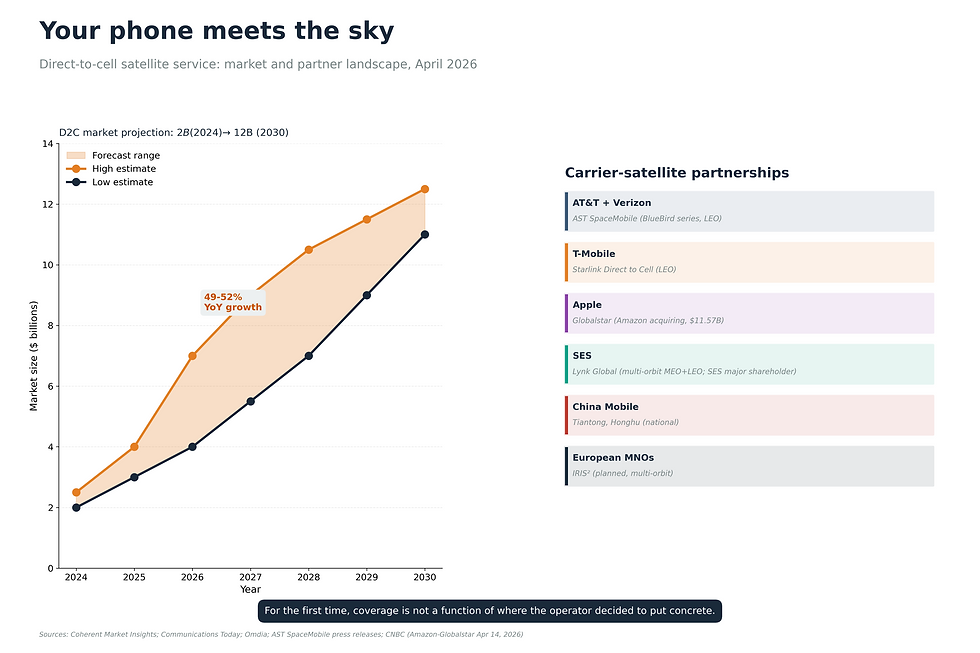
For 25 years, satellite phones were a separate device for a small audience. That era is ending. Direct-to-cell satellite service, which connects a standard smartphone to a satellite without any new hardware, is now a market in real money: roughly $4 to $7 billion in 2026, growing at 49 to 52% year over year, with analyst forecasts approaching $12 billion by 2030.
The competing architectures are already in field trials. AT&T and Verizon partner with AST SpaceMobile, whose BlueBird 6 satellite carries the largest commercial communication array ever flown in low Earth orbit. T-Mobile partners with Starlink for its Direct to Cell service. Apple partners with Globalstar, which Amazon announced it would acquire for $11.57 billion in April 2026. SES is investing in and partnering with Lynk Global to deliver multi-orbit direct-to-device service, with SES providing MEO-Relay routing between Lynk's LEO satellites and SES's MEO gateways; Lynk and Omnispace are merging with SES, taking a major strategic shareholder position. China is fielding its own direct-to-cell layer through Tiantong and Honghu. The European Union is pursuing the same capability through IRIS².
The customer experience is the point. The user does not change anything. The phone reaches a tower if a tower is there, and a satellite if it is not. For the first time in the history of mobile telephony, coverage is not a function of where the operator decided to put concrete.
12. Beyond radio: light is the next layer
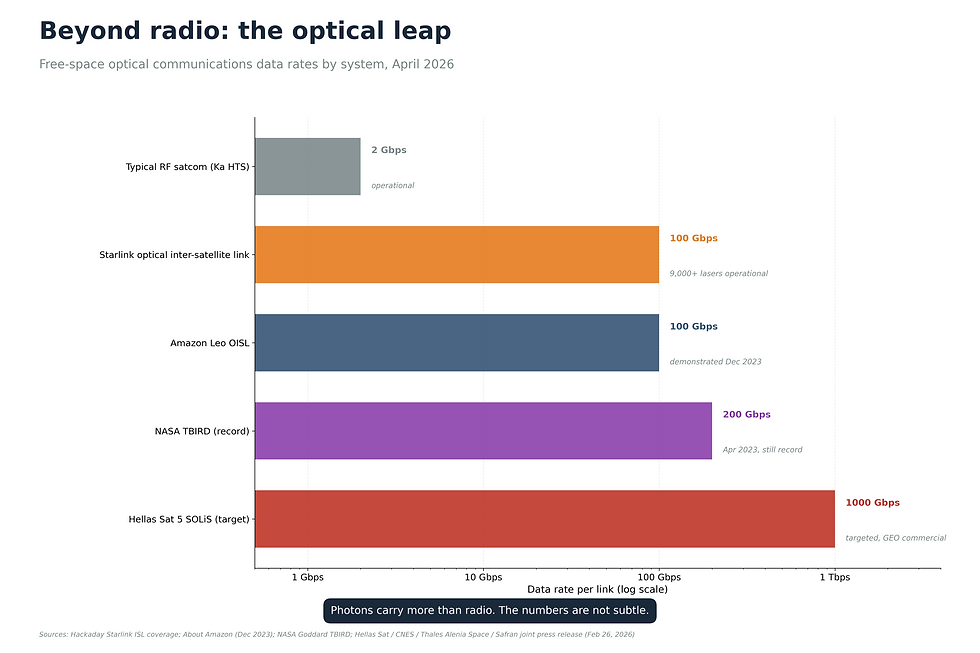
Radio frequency is finite. Photons are not. Free-space optical (FSO) communications use lasers instead of radio waves to move data between satellites and, increasingly, between satellites and the ground. The capacity numbers are not subtle.
Starlink's optical inter-satellite links carry up to 100 gigabits per second per laser, with more than 9,000 lasers now operating across the network. Amazon Leo demonstrated 100 gigabit-per-second laser links in December 2023 and is building the same architecture into the constellation it is deploying now. NASA's TBIRD mission set the space-to-ground record at 200 gigabits per second in April 2023, and the record still stands.
The next step is commercial. In February 2026, Hellas Sat, the French space agency CNES, Thales Alenia Space, and Safran announced a sovereign optical communications system, named SOLiS, that targets approximately one terabit per second on a future Hellas Sat 5 GEO satellite. That is roughly five times the existing public record and ten to one hundred times what high-end RF satcom systems carry today.
Optical communications also matter because terrestrial fiber is not as safe as it used to be. Submarine cable incidents are rising in the Arctic and elsewhere, and operators want resilience that does not depend on a cable on the ocean floor.
13. The satellite is becoming a software platform
For most of the satellite era, what a satellite did was decided when it was built and could not change once it was launched. That assumption is breaking.
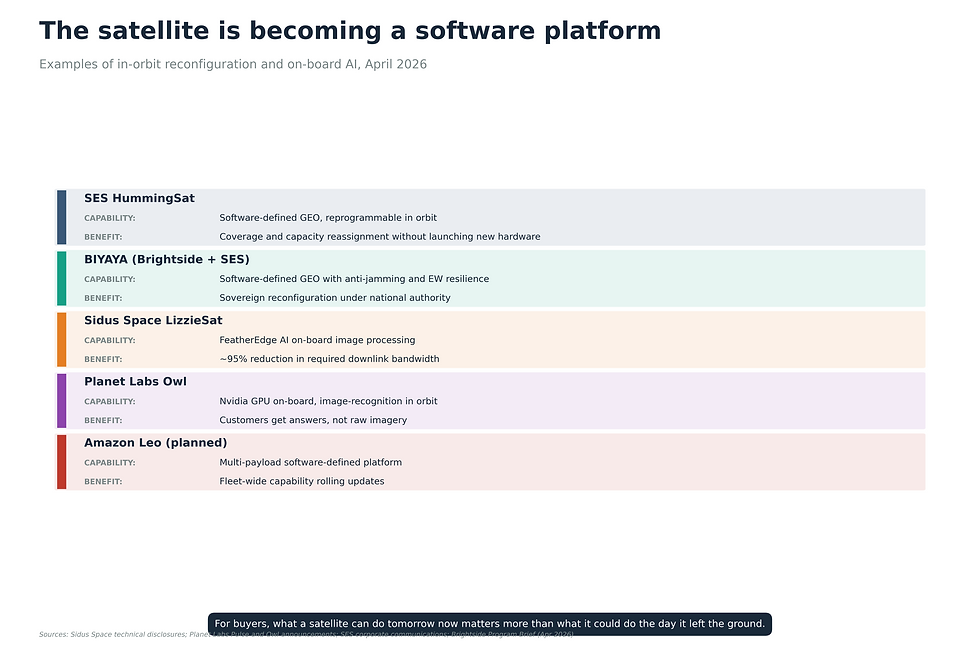
Software-defined satellites can be reconfigured in orbit. Coverage areas, frequency allocations, beam shapes, and even mission roles can be reprogrammed from the ground without touching the hardware. SES's HummingSat platform and the satellite Brightside is building for the Philippines are both software-defined GEO platforms designed to counter jamming and reassign capacity in real time.
On-board artificial intelligence is the second shift. Sidus Space's LizzieSat carries the FeatherEdge AI system that processes imagery on the satellite, sending only the useful data to the ground and reducing required downlink bandwidth by approximately 95%. Planet Labs is flying its Owl satellites with Nvidia GPUs that run image-recognition models in orbit. Defense and Earth observation customers want this because the alternative is downlinking petabytes of raw video and sorting it out later.
The result is a different kind of satellite. Less a fixed hardware appliance, more a remote compute node that happens to be in space. The implication for buyers is that fleet age starts to matter less than software capability, and the implication for builders is that the long-term value lives in the platform, not the metal.
14. The concentration risk
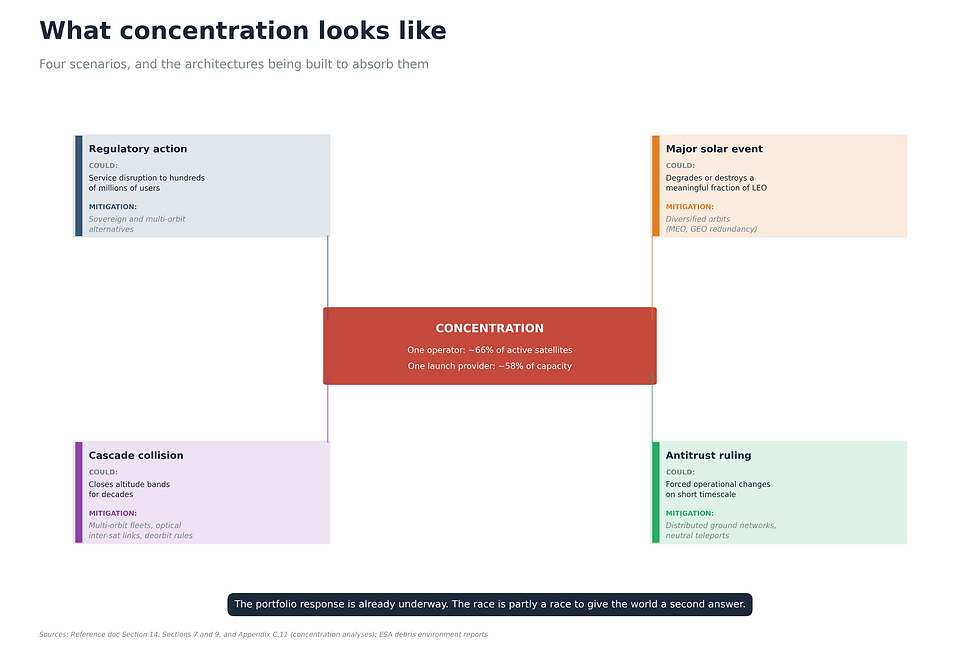
Concentration is what happens when one operator owns most of an industry. In April 2026, one operator owns about two-thirds of the active satellites, and one launch provider carries about 58% of the world's lift. Concentration is not a moral problem. It is a structural one.
Four scenarios are worth taking seriously. A regulatory action against the dominant operator could disrupt service to hundreds of millions of users. A solar event of the kind that occurred in 1859 would degrade or destroy a meaningful fraction of the LEO fleet. A cascade collision in the most crowded orbital shells could trigger debris growth that closes off altitudes for decades. An antitrust ruling could force divestiture or operational changes on a timescale that customers cannot easily absorb.
None of these is high probability. All of them are non-zero. The correct read is not panic. It is a portfolio. Customers, governments, and capital allocators who depend on space-based infrastructure are responding by funding alternatives: multi-orbit operators, sovereign programs, optical comms, and ground architectures that can route around any single failure. The race is, in part, a race to give the world a second answer.
15. The next 12 months
The watchlist for May 2026 through April 2027 is short, dated, and consequential.
July 30, 2026. Amazon Leo's FCC milestone of 1,618 deployed satellites. Amazon has formally requested a 24-month extension. The decision tells the market how the FCC will treat missed deployment milestones for everyone else.
Mid 2026. Telesat Lightspeed Pathfinder satellites launch, beginning the only direct LEO challenger to Starlink with credible institutional backing.
Second half 2026. Hellas Sat 5 GEO platform launches with the SOLiS optical communications payload, the first commercial test of one-terabit-per-second satellite communications.
Late 2026. SES and Brightside complete construction of the sovereign Philippine teleport at Morong, near Subic Bay, with service expected in the first half of 2027. The Philippine BIYAYA satellite enters final integration in France.
Late 2026 to early 2027. U.S. FCC ruling on the Upper C-band proceeding (NPRM 25-59) and UK Ofcom decision on Q/V band gateway access. Both reshape the spectrum economics for incumbents and new entrants.
Through 2026. ITU 10% deployment milestones come due for several megaconstellations. Operators that miss face proportional spectrum reductions.
Continuous. Qianfan and Guowang launch cadence in China. The pace will determine how serious the Chinese 28,000-satellite combined target is.
2027 launch year. BIYAYA launches from France. The Cagayan launch facility moves further into the build phase. The Brightside-and-SES sovereign-satellite model becomes a reference architecture for additional nations considering their own programs.
If the article has done its job, the reader can read these dates and understand exactly what is at stake in each of them.

Sources
LIVE TRACKERS AND STATISTICS
• CelesTrak SATCAT Boxscore (April 28, 2026). https://celestrak.org/satcat/boxscore.php
• Jonathan's Space Report (Jonathan McDowell, planet4589, April 21, 2026). https://planet4589.org/space/stats/active.html
• ESA Space Environment Statistics, DISCOSweb (January 16, 2026). https://sdup.esoc.esa.int/discosweb/statistics/
• ESA Space Environment Report 2025
INDUSTRY REPORTS AND ECONOMIC DATA
• Satellite Industry Association, State of the Satellite Industry Report 2025 (FY2024 data)
• Analysys Mason, "The satellite launch bottleneck may soon leave operators stranded."
• Novaspace / Summit Ridge Group conference notes, World Satellite Business Week, September 2024
• Gilat Satellite Networks, Investor Day presentation, Tel Aviv, April 1, 2025
• ESA / Novaspace, On-Board Radio Navigation Receivers Market Report, November 2024
• Royal Aeronautical Society, "Will launch capacity fall short?"
• Payload Space, "The State of Launch 2026" and "The State of Satcom 2026."
• SatBase, SpaceX Falcon 9 pricing analysis, February 2026
OPERATOR DISCLOSURES
• SES press release on Intelsat acquisition completion, July 17, 2025
• Eutelsat H1 2025-26 Management Report, February 2026
• Brightside Group S.A., Philippines Sovereign Satellite Program Brief, April 2026
• About Amazon, Project Kuiper / Amazon Leo launch progress updates
• Spaceflight Now, LA-06 launch coverage, April 27, 2026
• KSAT corporate disclosures, including the February 2026 ten-year milestone announcement
• Telespazio Space Centres and Teleports
• AWS Ground Station documentation
• Goonhilly Earth Station
• Iridium and Thales Alenia Space disclosures
• Planet Labs Pulse blog and corporate communications
• Sidus Space technical disclosures (LizzieSat, FeatherEdge AI)
• AST SpaceMobile press releases (BlueBird series, direct-to-cell)
REGULATORY DOCUMENTS
• FCC Order 22-74 (5-year LEO post-mission deorbit rule, adopted September 29, 2022; effective September 29, 2024)
• FCC Order DA 26-36 (Starlink Gen2 approval, January 2026)
• FCC NPRM 25-59 (Upper C-band proceeding, December 2025)
• FCC Second Report and Order, IB Docket 22-411 / 22-271, July 17, 2025
• ITU Radio Regulations and ITU-R Recommendation V.431-8
• ITU NGSO deployment milestone framework (WRC-19, November 2019)
• UK Ofcom, "Expanding Spectrum Access for Satellite Gateways," consultation document, July 22, 2025
• US Defense Information Systems Agency (DISA), Procurement, Defense-wide, FY2026 Budget Estimates, June 2025
• DataCenterDynamics, Amazon Leo FCC extension request coverage, February 2026
TRADE PRESS
• SpaceNews, multiple articles on launches, constellations, and spectrum
• Space.com, multiple articles on Starlink and debris
• Via Satellite, multiple articles on optical communications and operator strategy
• Aviation Week, "Global Orbital Launch Rate Jumped 25% in 2025"
• Hackaday, Starlink optical inter-satellite link coverage
• Capacity Magazine, SES-Intelsat merger analysis
• Manila Times, "Complying to BBM directives, Brightside advances strategic comms deal," November 25, 2025
• CNBC, Amazon-Globalstar acquisition, April 14, 2026
• Newsbytes.ph, "Cagayan eyed for future PH spaceport project," March 5, 2026
STANDARDS BODIES AND ACADEMIC
• ITU-R Recommendation V.431-8 (August 2015)
• ESA Satellite Frequency Bands
• NASA Goddard, TBIRD project announcements
• MIT Lincoln Lab, TBIRD project page
SPECIFIC ANNOUNCEMENTS REFERENCED
• Hellas Sat / CNES / Thales Alenia Space / Safran joint press release on SOLiS, February 26, 2026
• PhilSA / DICT / CEZA / Ascend International Gateway / Perigee Aerospace MOU on Philippine spaceport development, March 4, 2026
STRATEGIC AND POLICY ANALYSES
• Anniki Mikelsaar, "Ruptures at the Top of the World," ICDS, September 2025
• TMA-25 paper, "Measuring the OneWeb Satellite Network," University of Victoria, December 2024 to April 2025
NOTE ON FIGURES
All counts of active satellites are best-available estimates as of late April 2026 and will continue to drift as launches and re-entries occur. Where ranges exist, this article uses the most recent live tracker data as the anchor and supplements it with operator disclosures, regulatory filings, and the SIA economic data set.
For the BIYAYA program specifically, all details in this article are consistent with the public-disclosure boundaries set by Brightside Group S.A. for public-facing materials. Details beyond what appears in this article are held in internal reference materials only.
~ Mark Munger, CTO, Brightside
Click above to download report.



Comments